Saturday, 31 December 2011

Chamber Raid: Hackers Target US Commerce Lobby

Chamber Raid: Hackers Target US Commerce Lobby
News that the U.S. Chamber of Commerce had been hacked by intruders using China-based servers surfaced recently, though the attack actually happened many months ago and the extent of the data breach is still unclear. The Chamber reportedly learned of the break-in only when it was informed by the U.S. Federal Bureau of Investigation.


As the U.S. government continues to pound out proposals for getting its IT security ducks in a row, it appears it's not the only party in Washington, D.C., to have a problem with network intrusion.

IT systems belonging to the lobbying group the United States Chamber of Commerce were breached by hackers using servers located in China, according to The Wall Street Journal.

The Chamber reportedly learned of the break-in only when it was informed by the U.S. Federal Bureau of Investigation. China's government has denied accusations that it was behind the hack.

The Chamber's members include most of the largest U.S. corporations, and the organization has more than 100 affiliates worldwide.

"We are already involved in a cyberwar with China, and we are only reading about a small percentage of the actual attacks that are occurring," Darren Hayes, the CIS program chair at Pace University, told TechNewsWorld.


About the Chamber Breach

Evidence reportedly shows the hackers were in the chamber's networks for at least six months, from November 2009 to May 2010. The breach of the chamber's systems was discovered and shut down in May of 2010, and it's not clear just why the information has leaked out more than 18 months later.

The attack is said to have involved at least 300 Internet addresses. Chamber officials apparently said internal investigators found that the hackers had focused on four employees who worked on Asia policy and had stolen six weeks' worth of their emails.

Some people familiar with the Chamber's internal investigation apparently believe that the hackers are suspected by U.S. officials of having ties to the Chinese government.

However, security experts have repeatedly said that suspecting a government of being behind cyberattacks because servers are located in its territory may be misleading, as cybercriminals often set up servers abroad to avoid detection, and it's easy to do so in China.

The Aftermath of the Attack

The Chamber of Commerce reportedly concluded that communications with fewer than 50 of its members were compromised, and it notified them. However, there's apparently been no evidence of harm to the organization or its members.

It's not quite clear what else was stolen, but the intruders used keyword searches to peruse documents in the chamber's servers.

The chamber reportedly found that the hackers had built at least six back doors to let them enter and leave the system as they pleased. They apparently also built in mechanisms that would communicate with computers in China every week or two.

A thermostat at a town house the chamber owns on Capitol Hill was reportedly communicating with an Internet address in China, and, in March, a printer used by chamber executives began printing out pages with Chinese characters.

The Circle of Life

Perhaps the chamber was the author of its own cybersecurity problems. It had circulated an internal draft document in May criticizing the White House's legislative proposals on cybersecurity as regulatory overreach, according to the Journal.

The White House had sent this proposal to Congress.

The main reason for the chamber's opposition was reportedly that the White House plan would require some companies running the most critical infrastructure to submit to more rigorous outside oversight of their cybersecurity practices. This would be costly, and cybersecurity assessments of companies by U.S. government agencies would be made public.

Cybersecurity experts warned at the time that this could sabotage the White House's efforts to beef up cybersecurity.

The Cybersecurity Full Court Life

"The fact that the Chamber ... had to be alerted by the FBI ... shows they did not have the appropriate endpoint monitoring capabilities and log management technology in place to see who was accessing their data and where it was going," Dave Pack, manager of LogRhythm Labs, told TechNewsWorld.

The chamber reportedly unplugged and destroyed some computers and overhauled its security system over a 36-hour period one weekend, thought that amounted to cleaning up after the fact.

"There is no denying that attacks will happen and the bad guys will get inside," Ken Pickering, development manager of security intelligence at Core Networks, told TechNewsWorld. "We advocate that an organization focus first on breach prevention instead of considering detection and isolation to be the only option," Pickering said.

Friday, 23 December 2011

Tech: Connecting homes and businesses

A self-confessed tech geek aims to provide pain-free and efficient communications for business and residential premises, writes ROZANA SANI

Ng demonstrates the IP-based services available to GTower tenants
AFTER months of anticipating and planning, you finally get the keys to your new office. Raring to go, you suddenly have to put your plans on hold because you find that it is simply not feasible to start operations. There is no Internet service, phone lines have yet to be installed and all this will involve hacking walls for wiring and cabling.

Some owners of new homes also have the same predicament. Not only is time wasted waiting for the communications service to be ready for use but home owners and office tenants also have to first do the painful legwork of identifying providers and contractors who can fulfill their requirements.

But it need not be like that, says Macro Lynx Sdn Bhd chief executive officer Rick Ng.

“What will be ideal is having the property developer incorporate communication solutions development from the word go and having them in sync from the start.

Residential occupants and business tenants today appreciate the convenience of high speed broadband and property developments that offer such plug-and-play facilities will certainly be more attractive,” says the 38-year-old geek turned businessman.

Ng has a telco background which includes designing a variety of communication networks. But he felt the urge to enter the business and corporate world to give customers what he himself would want as a property owner or tenant.

“Macro Lynx aims to be to be the number one Internet service provider of choice at every location we serve and to be the ICT infrastructure consultant of choice for property developers in the country. Our mission is to provide comprehensive end-to-end IP-based business communication solutions that improve lifestyles and work styles for our customers,” he says.

Macro Lynx is a registered licence holder of the Individual Network Facilities Provider (NFP) and Network Service Provider (NSP) with the Malaysian Communications and Multimedia Commission.

The company provides broadband Internet access and services for commercial, residential and hotels under the myLYNX Broadband brand name. Among its projects are the Mid Valley City, Menara UOA Bangsar, Empire Subang, GTower and The Heritage.

“It is important for businesses and technology users to be in touch with communities, accessing information and knowledge especially in the knowledge-based era. We offer broadband Internet building design and build services based on wireless LAN, Ethernet, Power Line Communications (PowerLAN), fiber optics and xDSL technologies.

“Most of our customers would like their staff to focus on their core businesses. So our value-added services are extended to network monitoring and alert solution, broadband Internet usage and alert solutions, firewall support services and web content filter support services,” says Ng.

Macro Lynx also designs and builds smart homes with wireless web camera and home automation services as well as smart cities with wireless web surveillance camera services.

It also designs, builds and integrates web-based ISP management systems that include broadband asset, customer service, work order and service provisioning, fault, wired/wired path, traffic, billing, contracts and subscriber management and builds and commissions network infrastructure for new start up offices as well as revamps existing office set-ups.

For its managed network services, Macro Lynx has a dedicated team of customer service personnel to keep customer satisfaction level high at all times.

“We understand our customers’ concern when things don’t work at their premises.

 We provide technical support to help them trouble-shoot internet problems remotely or, where necessary, on-site,” he says.

Its customer service personnel is available seven days a week, to respond to customers’ calls.

“Our service response is within two hours from the time the call is recorded. Telephone support is available 24/7,” assures Ng.

Ng says while giga bandwidth is now possible, he looks forward to a time that bandwidth is affordable.

“As a telco neutral provider, I think a lot more can be done for users, whether business or residential, when shared facilities and equal access are made a reality. That way there is no redundancy in terms of telecommunications infrastructure investment. This will result in a greener environment and better access to infrastructure and services for customers,” he adds.

Smart and green

Located at the intersection of Jalan Tun Razak and Jalan Ampang, GTower is designed and built from the ground up to be a Smart IP enabled building with green features. The infrastructure is the first of its kind in the country that provides for future bandwidth so tenants and customers can enjoy a rich online experience. The design of the infrastructure allows for quick and rapid installation and commissioning of broadband within hours instead of the traditional seven to 10 working days.

All things mice

MICROSOFT is ushering Chinese New Year 2012 by reworking the exterior of a couple of mice, the Wireless Mobile Mouse 3500 Year of the Dragon and the Arc Touch Mouse Year of the Dragon editions.

iNuke Boom   iNuke Boom  DUAL-CORE MONSTER  DUAL-CORE MONSTER


The former will feature an intricate dragon design created by premier artist Nod Young, who was inspired by the famous Nine-Dragon Wall in Beihai Park, China, as well as the popular Dragon Ball cartoon series. The dragon mouse comes with the award-winning BlueTrack Technology as well as a snap-in Nano transceiver, enabling it to work just about anytime, anywhere on most surfaces. As for the Arc Touch Mouse Year Of The Dragon, it has a sleek crouching dragon design which matches the special Arc Touch Mouse form factor, letting you bend, snap and stow to accommodate the ultimate road warrior.
The Wireless Mobile Mouse 3500 Year Of The Dragon, in traditional red and gold colours, is expected to sell at US$34.95 (RM111) while the Arc Touch Mouse Year of the Dragon is going for US$69.95. Details at www.microsoft.com/hardware/en-us/p/
DUAL-CORE MONSTER
Meizu used to make the headlines simply because it supposedly had an iPhone killer in the works back in 2007, but it seems that the effort fizzled out over the years, with Samsung and HTC coming close with their range of Android-powered handsets instead. However, Meizu is back with its latest effort — the Meizu MX. This device runs on a dual-core 1.4GHz processor, aided by 1GB RAM, an eight-megapixel back-illuminated camera and LED flash, accompanied by a gyroscope and a plethora of other sensors. Sporting a clean, intuitive and minimalistic design, the Meizu MX is also equipped with a gorgeous 10.16cm high resolution (292 PPI) AVS display with the ideal 3:2 aspect ratio. Not only that but its custom-designed user interface based on the Android operating system, known as Flyme OS, is said to be a snap to use, although it seems that the Meizu MX is only destined for the China market, at the moment.
The 16GB Meizu MX is expected to arrive in China from Jan 1. Hopefully someone will run a parallel import to Malaysia as it does look like a sleek looking handset to own and use. Details at www.meizu.com.hk.
HAVING A BLAST
So you reach home after a long, hard day at work, and decide that some heavy metal music is what’s needed to help you vent the day’s frustrations, only to realise that the puny iPod dock that you own in the living room is not able to express your emotions across the audio spectrum.
You check online for a heavy hitter, and chances are you won’t be able to peel your eyes away from the Behringer iNuke Boom, touted to be the loudest iPad, iPhone and iPod dock in the world, or at least, when it is presented at the Consumer Electronic Show (CES) next year.
Retailing for a monster US$2,999.99 to go along with its behemoth-like speaker system performance and dimensions, the iNuke Boom measures 8ft (2.44m) wide by 4ft in height and tips the scales at more than 300kg. It is capable of bringing the house down (and the police knocking on your front door!) at over 10,000 watts of power.
I can just imagine blasting all those classic rock and metal tracks with the iNuke Boom. You won’t be winning your neighbours over, but at least it helps you vent the day’s stress away. Details at www.behringer.com.
ALL THE RIGHT CURVES
HTC has just unveiled its latest smartphone here. The HTC Explorer targets the mid-range market, coming in a curved and compact design with a 3.2-inch HVGA touchscreen display, a three-megapixel shooter located at the back, as well as the custom HTC Sense 3.5 user interface that certainly makes it a whole lot easier to use compared to the stock Android user interface. The new lock screen allows for quick and easy access to the camera with a mere swipe, and there is also a new Smart Dialer which displays a one-touch menu for quick, easy dialing of contacts.
While Adobe may have killed off future developments for mobile Flash, that does not mean Flash is dead on the mobile platform right now. No. The HTC Explorer supports Flash in its browser for a rich Internet experience, while smart URL prediction makes it easier for you to access the top 100 websites.
Running on a 600MHz processor, the HTC Explorer also features 512MB RAM, 90MB of internal memory that can be augmented by a microSD memory card slot, Bluetooth 3.0 and WiFi connectivity, and GPS support.
The HTC Explorer comes in just one shade — metallic black, where it will retail for a highly affordable RM749. Why not wrap this and place it under the tree this holiday season? Details at  www.htc.com/sea/

Mobile Apps Forum

Mobile Apps ForumRULE OF THE APPS: The Hand-Held Rich Experience
If we agree that a mobile application is software which runs on a handheld device that can connect to networks, and is based on an operating system that supports standalone software, we must also agree we are not only talking about native apps that can be downloaded from an apps store, but we are also talking mobile web apps that run through a browser. These are designed to run reasonably well via almost any smart mobile web browser.
Mobile applications are now taking us to the direction of only discussing features on smart phones, while most of the nation is still carrying traditional (feature) phones. Within the exhibition hall itself mobile apps presentations will be running from multinationals claiming they have the best platforms, to young entrepreneurs seeking to prove them wrong and showing their own development.
And these are not the only issues when it comes to smart phones. They actually constitute a significantly small percentage of the Arab African mobile phone users and are not to make a major leap until problems related to price, complexity of use, battery life and others are settled. The public will listen, evaluate and give feedback. The time of one-way talk is over, it is springtime and everyone is entitled to an opinion to be expressed at the Cairo ICT 2012 Mobile Apps Forum.

In the wake of the Revolution: Insights on Egypt's ICT sector

Full Article
When young Egyptians decided that mobilization was needed for reform, they resorted to the Internet. In practical terms this means social media. Those who pursue more participatory governance in Egypt find that the online world is giving them space and ownership. And we are proud of this advanced philosophy.

Mobilization and further actions were possible for the People's Revolution of January 25th because the ground had already been prepared. Infrastructure and technology platforms, a technology-enabled youth community, access to ICTs and different modes of self/freedom of expression both on and offline were all in place combined with, of course, a genuine conviction for a better Egypt.

As we all agree, technology played a specific role in the Revolution. It helped in spreading awareness and confidence, creating solidarity, organizing, mobilizing, maintaining momentum, and participation at limited cost.

Strategic plans

Since 2000, Egypt's government, in collaboration with the ICT private sector and NGO communities, has taken the responsibility to lead Egypt into the information society. Several initiatives in line with global trends were put into action. Strategic plans paved the way: for the years 2000-2003 state-of-the-art infrastructure,a liberal legal environment, access to ICT services and tools were the focus. The period 2004-2006 witnessed developmental initiatives on several fronts: education and learning, health, and government services. Developing and exporting added value out of Egypt and creating a talent base to serve such niches were the targets between 2007 and 2010. For the next five years we will focus on innovation and entrepreneurship with an emphasis on youth, start-ups and SMEs in support of reform efforts.

The Revolution is a true testament of how Egyptians value what technology can do for them and what they can do with it. Forecasts confirm that Egyptians will continue to utilize ICTs in the quest for long-term political reform and development.

During this coming period our vision is to capitalize on such achievements and proud wins. Building on this potential and effort, our aim is to empower political participation and civil engagement.
The focus will be on 'inclusion’ (participation) and not 'exclusion’. New technologies and the Internet are the supportive arms of delivery. The government confirms that creating the enabling environment is its mandate.

There is a strong drive to improve citizens’ access to information and knowledge, and to encourage public involvement. This is synonymous with transparent and accountable services and procedures in which individuals have access to their own data and can manage its privacy and, more importantly,are able to utilize such data as a tool for inclusion.

In conjunction with revisions of laws, technology will be used to ensure that participation, especially in voting, is fair and accurate. Ensuring accurate voter lists is a first and guaranteed step. The next step is to develop the infrastructure and tools that would allow e-voting, especially to allow Egyptians in diaspora to take part, but this will require modification of the law and the development of highly secure systems.

Let me shed light on one of our major challenges that – as a government – is being given high priority. This is unemployment. The ICT sector played a key role in addressing this challenge over the last decade. The two most solid experiences are the export of IT services and products (off-shoring and outsourcing) and developments in the telecommunicationssector (both mobile and fixed).

Large investments have been made in capacity building and human resource development for those two specific lines of business. Today, Egypt is being marketed as havingan excellent talented workforce based on a technology savvy, language capable generation. Egypt supplies technical expertise and developers of technology to the region with a niche in Arabic services and applications.

A model for reform

Egypt's ICT sector stands out as a model for reform:from policy regulations in telecommunications to a full-fledged community, to a sustainable flow of global investments to a bouquet of public-private partnerships. The impact of those efforts on the economy and society was truly sound.

Telecom Egypt, our incumbent operator, is a global success story. The management of Telecom Egypt has been privatized and the company is partially owned by the public and the government. The success of the company yields annual support to the public treasury.

Broadband is at the heart of strategy for the period 2011-2015. Developing a complete roadmap adaptable to an evolving market and accommodating advancing technologies is a clear objective. Looking at the economic potential and impact of the development of such an industry from both a macroeconomic standpoint to a more focused outlook on other sectors of the economy, to looking further internally on the telecommunications sector from an infrastructure standpoint confirms Egypt's commitment. Strategies and policies dedicated to broadband aim to stimulate growth through competition, demand and new business opportunities.

Amidst the challenges our nation is facing while working its way on the road to reform, we see budding hope and faith. The ICT community of Egypt is a model. Rarely can one find civil society activists, philanthropists, influencers and leaders from the political as well as the business scene, gathering to share a common agenda for change. We gather around a clear vision which aims to ensure the people's right to communicate, a safe and secure cyberspace, and innovation for digital participation. Knowing that technology and its applications are a result of human intent and need, it will always remain an effective partner to traditional offline networking and activism.

Well it’s happening, in the spirit of the Revolution, and inspired and fuelled by enthusiasm and the commitment of local and global partners there is a strong belief in our younger generation and their role in solving today's challenges with the technologies of tomorrow. Plan 2011-2015 aims at the utilization of ICTs in the everyday life of Egyptians; innovation and entrepreneurship are its key components.

Cairo ICT 2011

Cairo ICT 2011
“Destination Egypt... A Future in The Making”
Cairo ICT 2011 once again proved itself as a premier event that serves the Middle East and Africa, where professionals are treated to a wealth of learning and networking opportunities.
From May 25 – 28, Cairo ICT hosted business leaders from Egypt, the Arab Region and Africa, government officials, foreign dignitaries and VIPs to discuss the current state of the ICT industry in Egypt after the revolution.
The four exhibition halls played host to the largest players in the industry. The sheer size of the exhibition and the number of attendees was impressive to everyone, fulfilling the slogan: “Destination Egypt... A Future in the Making”.
Cairo ICT Expands in Size & Scope
Cairo ICTDespite the repercussions of the January 25 Revolution, Cairo ICT in its 15th round kept the same size and scope of 2010’s round which indicates that the ICT industry is a key sector for the revival of the Egyptian economy and all its other sectors, while also indicating the strength of the event.
Thursday, 22 December 2011

The Evolution of the Web

http://evolutionofweb.appspot.com/
The Evolution of the Web
Over time web technologies have evolved to give web developers the ability to create new generations of useful and immersive web experiences. Today's web is a result of the ongoing efforts of an open web community that helps define these web technologies, like HTML5, CSS3 and WebGL and ensure that they're supported in all web browsers.
The color bands in this visualization represent the interaction between web technologies and browsers, which brings to life the many powerful web apps that we use daily.


Friday, 9 December 2011

Zimbabwe ICT Africa 2011’s best exhibitions

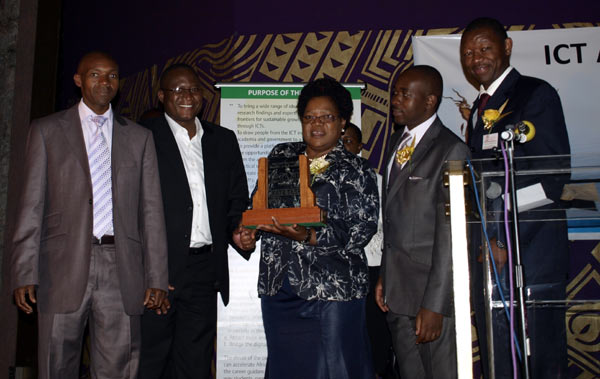
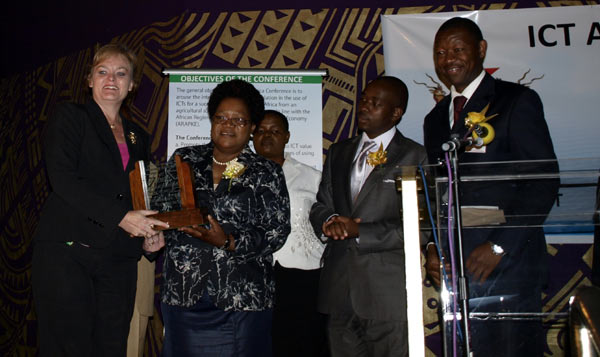
ICT Africa 2011, the Vice President of Zimbabwe, Joice Mujuru presented awards to the most outstanding exhibitions. Two awards were presented, the first for the best stand at the exhibition and the second for the most innovative product.
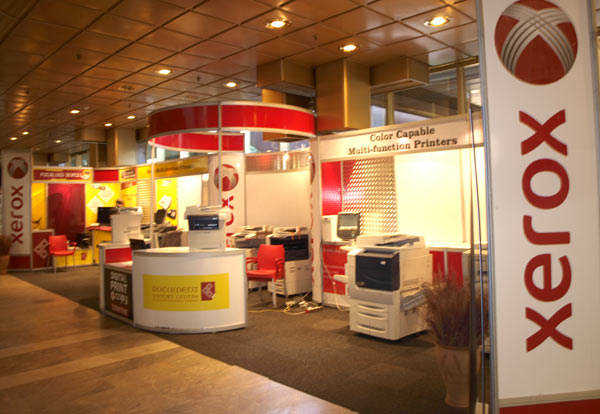
The first award was won by Document Support Centre, the official representatives of Xerox in Zimbabwe.
VP Joice Mujuru hands over award to DSC representatives while ICT Minister Chamisa & COMSA President Mukusha look on
Here’s a picture of the Document Support Centre stand that won them the award.

The second award went to Utande, an Internet Access Provider. The product that won the price is a cloud computing platform the company has launched to deliver Software as a Service. Utande demonstrated a live Sage ERP application running on their cloud platform.

http://www.techzim.co.zw/2011/10/zimbabwe-ict-africa-2011s-best-exhibitions/

Malaysia ICT Sector Highlighted in MSE 2011

Dubai, 29 March 2011: MSC Malaysia's presence within the GCC area is set to be further enhanced by its participation at the Malaysia Services Exhibition (MSE 2011), which will take place from January 17- 20 at Abu Dhabi National Exhibition Centre (ADNEC). The UAE is among the Top 10 countries of export for construction-related professional services firms. The ICT industry in Malaysia estimated to provide 50,000 total jobs and RM5.5bn investments by 2015
Twenty of the top MSC Malaysia-status ICT Services companies ranging from those involved in Software Applications and Services to Outsourcing Solutions and Services, will represent the ICT sector at MSE 2011. The companies are Lead Agency: Multimedia Development Corporation (MDeC), Collaborators: The National ICT Association of Malaysia (PIKOM) and New Entrepreneur Forum (NEF).
MSE 2011 follows the success of the previous such exhibitions held in Sharjah 2008, Dubai, 2009 and 2010. The exhibition, organised by the Malaysia External Trade Development Corporation (MATRADE), will bring a range of services from 6 industry clusters, bearing the Malaysian hallmark of excellence, under a single roof.
Market Overview Malaysian IT spending is expected to grow to U$5.2bn in 2011, from US$4.8bn in 2010, when the market stablised following the impact of a difficult economic and political situation. The market should be boosted by ICT-friendly 2011 budget measures and growing interest in cloud computing, but much will depend on confidence in a sustainable economic recovery.
Software Malaysia's addressable software market is expected to growth to US$857mn in 2011, consolidating a recovery in 2010 but businesses remain cautious and focused on ROI. By 2015, we forecast software spending rising healthily to US$1.3bn, with software CAGR for 2011-2015
According to H.E. Dato' Yahaya Abdul Jabar, the Malaysian Ambassador to the UAE, ICT companies participation in MSE 2011 are examples of the comprehensive, credible and cutting edge ICT services we offer to world at competitive costs. MDeC is the lead agency spearheading the MSC Malaysia project. MSC Malaysia is a national initiative spearheaded by the Malaysian Government to promote both the national ICT industry and provide a test-bed for the global ICT industry.
Currently, there are more than 1,900 ICT companies operating within the MSC Malaysia area, ranging from Internet-based business solutions and services providers to software application and services providers. Some of the sectors where Malaysian ICT companies can provide world-class applications include Financial Services Industry (FSI), Telecommunications (Telco) and e-Government services.
He added that MSC Malaysia industry development programs have produced globally competitive ICT companies delivering award winning solutions and world class service. These leading companies have successes in their delivery across continents covering Asia, Europe, US, Africa and the Middle East.
They include N2N Connect, which provides mobile trading technology for the Financial Services Industry in over five continents; Custommedia with their world class software testing solutions and services; Britesoft - providers of most advanced non-coding software development tools and services; Xybase is today's leading Total Airport Management System and services with more than 20 international airport implementations globally, just to name a few.
Business owners and multinational corporations in the region should not miss the opportunity to experience how MSC Malaysia empowers Governments and businesses through one-to-one business meetings and round-table discussions, Dato adedd
Mr. Saifol Bahri Shamlan, Vice President Industry Development, Multimedia Development Corporation (MDeC), said, "The facility was estimated to provide 50,000 total jobs and RM 5.5bn investments by 2015. He said cloud-based computing services are set to become the next engine of growth and that Malaysia was well placed to be a reference model for solutions engineered for the world. MDeC has taken on the challenge to develop an entire IT industry for Malaysia by re-shaping the corporation's industry development functions into an organisation that performs end-to-end aid in development, growth and commercialisation of numerous players in Malaysia's IT industry."
Ahmad Asri Abdul Hamid, President of Professional Services Development Corporation (PSDC), said: "114 construction related professional services firms from Malaysia export to 63 countries and were involved in 517 completed and ongoing projects. Construction-related firms have the most presence in ASEAN, closely followed by the Middle East and South Asia. The UAE is among the Top 10 countries of export for construction-related professional services firms.
He addes: "Malaysia has placed great emphasis on development of Green Technology services. Malaysian consultancy firms have the experience and expertise in developing green projects, both locally and internationally. They are able to offer their services at competitive cost. He said PSDC was positioned to identify and facilitate involvement of Malaysian consultancy firms in the global market."
Other industry clusters represented at MSE 2011 are: Professional Services, Energy and Power Generation (Engineering, Architect, Interior Design, Urban Planner, Landscaper, Energy and Power Generation), Construction and Related Services, Oil and Gas, Specialised Training & Business Services and Environment Management Services.
MSE Objectives
* Promote services from Malaysia to West Asia and surrounding regions (MENA) - Gain and further enhance the visibility of Malaysian services capabilities and expertise;
* Brand Malaysian services by showcasing Malaysian companies' achievements in the international arena;
* Provide an avenue for Malaysian services providers to network and forge strategic alliances with their potential clients or partners overseas; and
* Provide a platform for international businesses to source the best of Malaysian services for their needs

Government CXO Malaysia’s GCIO shares new govt ICT masterplan

In 2020, Malaysia will become a ‘high-income nation’ that is both ‘inclusive and sustainable’, according to the vision laid out by the government.
 Dato’ Dr Nor Aliah bt Mohd Zahri, the country’s Government Chief Information Officer, says that the new government ICT plan, which is currently being finalised, will play an indispensable role in achieving this vision.
Malaysia’s first public sector ICT plan, launched in 2003, was completed in 2010. Dr Nor Aliah is also the Deputy Director General (ICT) of Malaysia Administrative modernisation and management planning unit, a special agency affiliated to the Prime Minister’s Department.
Four strategic thrusts have been identified in order for the government to realise its vision for 2020. That includes: “1Malaysia, People First, Performance Now”; Government Transformation Programme (GTP); Economic Transformation Programme (ETP) and the 10th Malaysia Plan.
Various programmes are developed to address the ICT requirements for the government in the above-mentioned areas over the next five years.
The focus of GTP, reveals Dr Nor Aliah, is ‘deliver big results fast’. Three phases of implementation have been laid out: the first phase, started last year, will last until 2012; the second phase will last between 2012 and 2015, and the third one predicted to end in 2020. The programme focuses on six areas: reducing crime, fighting corruption, improving student outcome, raising living standards for low-income households, improving rural basic infrastructure and improving public transport. In the 10th Malaysia plan, budgets are allocated for government to implement the strategies that have been identified.
Looking at global trends, Dr Nor Aliah says that the challenges in Malaysia are also about sharing of information and services in order to achieve greater efficiency and improve citizen service delivery – goals specified in the 1Malaysia vision.
The public sector ICT blueprint, under which all agencies and departments will work towards the common goal, incorporates four key concepts: Information strategy which “enhances information sharing”, “ICT Governance”, “Managing Knowledge Effectively”, as well as “Strengthening the infrastructure architecture”.
For information architecture blueprint aims to achieve a whole-of-government by providing connected service delivery. The government will identify the business architecture components and map it into the information architecture components. The goal is to enhance public facing delivery channels, provide a common architecture standard for information sharing as well as enhance collaboration by identifying common, shareable and reusable information.
The phases will include building the foundation, achieving connected service delivery and finally seamless sharing of information by 2015.
In the area of governance, Dr Nor Aliah says of strengthening the governance structure is to “support and align with the national strategic priorities and initiatives by creating a more responsive governance environement to improve speed of decision-making and delivery”.
The strategy to build an informed knowledge environment includes the building of a Knowledge foundation programme, knowledge practitioner development programme as well as rewards & recognition programme. In addition to inculcating the culture of knowledge management, the government will also strengthen knowledge management initiative in the public sector through development of high impact knowledge management projects and intelligence hub programme. The objective is for an “Existence of a Centralized Knowledge Management Hub for the public sector” in five years’ time.
Dr Nor Aliah highlights the concern that currently “public sector ICT infrastructures are currently not fully optimised due to redundancies and inefficiencies resulting from disparate ICT infrastructure”. To increase the productivity, the government plans to consolidate public sector network, data centres & disaster recovery centres, establish public sector cloud computing infrastructure, standardise end user computing infrastructure, develop common security infrastructure, deploy mobile computing solutions and increase the usage of open source applications.
The public sector ICT framework has been developed, which include ICT governance and change management components.
“In many areas, the government services are available but the usage rate is very low,” says Dr Nor Aliah, who adds that one of the objectives is to make sure more people use government services. Seven strategic objectives have been identified as part of the business strategy plan; these include streamlining ICT architecture; consolidating ICT operations; intensifying inter-agency collaboration; rationalising ICT governance structures; attracting, developing and retaining top talent in the public service; strengthening the performance culture and fostering knowledge culture.
Numerous KPIs have been set in the areas including online services, paperless government, sharing of information and shared services. “All these contribute to the framework of our public sector ICT plan,” says Dr Nor Aliah.

2